

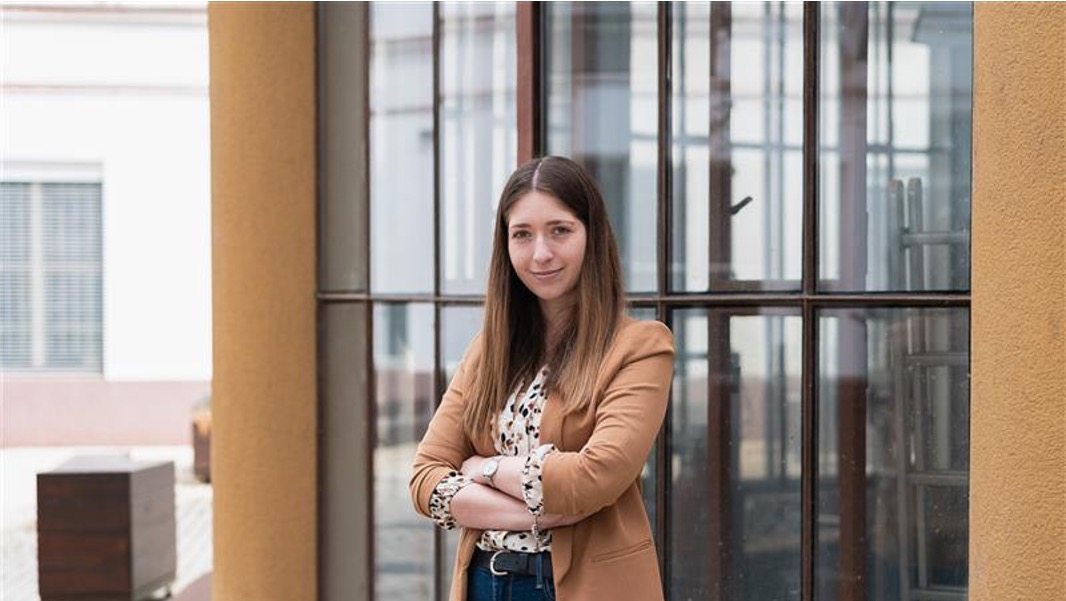
Alumni Interview: Petra Špringer Šimonová – A PhD That Opened Doors Abroad
In this part of the CROSS interview series, we present inspiring stories of PhD graduates and their career paths. This time, we spoke with Petra Špringer Šimonová, who, after completing her PhD at the University of Chemistry and Technology in Prague, smoothly transitioned into academia as a postdoctoral researcher and fellow of the prestigious Alexander von Humboldt Foundation at the University of Bayreuth.
In the interview, she shares her experience of transitioning from doctoral studies to an international research environment, reflects on the key skills she developed during her PhD, and offers practical advice for current doctoral candidates. Her story highlights the importance of not only disciplinary expertise but also engagement in the broader academic community and the development of transferable skills.
Could you briefly introduce yourself?
I’m Petra Špringer Šimonová, a postdoctoral researcher and Alexander von Humboldt Fellow at the University of Bayreuth in Germany. I completed my Ph.D. in Chemistry and Technology of Materials in 2025, and during my doctoral studies I also spent time in France through an international research exchange.
What field did you study, when did you complete your PhD, and what was the focus of your research?
I completed my Ph.D. in Chemistry and Technology of Materials in 2025 at the University of Chemistry and Technology in Prague. My research investigates the relationships between microstructure, composition, and the resulting properties of ceramic materials. During my Ph.D., I focused on oxide and silicate ceramics and now I am transitioning to ceramic matrix composites (CMCs), aiming to advance the understanding of how microstructural design influences the properties of these complex composite materials.
What did your transition into your current job look like after completing your PhD?
The transition was quite well planned and, in the end, smoother than I expected. I started looking for postdoctoral opportunities about a year before finishing my PhD, so by the time I defended, my postdoctoral position funded by the Alexander von Humboldt Foundation at the University of Bayreuth was already secured.
What was the most challenging part of this transition for you, and what helped you the most?
The most challenging part was and still is getting used to a new environment and working culture. I spent about eight years at the same university and even within the same research group, so this change was significant. Another challenge is entering a new research topic, which sometimes makes you feel like a student again. What helped me most was staying open and don’t be afraid of asking questions.
In what ways did your doctoral studies help prepare you for your current job?
Since I stayed in academia, the transition itself was not as drastic as it might be for someone moving to industry. What helped me most during my PhD was not only the research experience, but also the opportunity to be involved in activities beyond research, such as organization within the ceramic societies, the university academic senate, or PhD student support group. These experiences helped me develop skills that are valuable regardless of whether I stay in academia or move to industry in the future.
Which skills you gained during your PhD do you use the most today and consider the most important?
Strong research skills are, of course, essential and directly connected to my PhD work. In addition, presentation and communication skills, developed through regular conference participation, are extremely important in my current role. I also rely a lot on soft skills gained through voluntary activities, such as teamwork, organization, and effective communication, which are crucial in everyday professional life.
Did anything from your PhD turn out to be useful even outside academia in ways that surprised you?
Since I have stayed in academia so far, I don’t yet have enough direct experience outside it to fully answer this question. However, I can already see that many skills developed during a PhD such as problem-solving, independence, and the ability to communicate complex ideas clearly are highly transferable and would be valuable in many professional environments.
What would you recommend current PhD students not to underestimate during their studies?
I would strongly encourage PhD students to not focus only on research. Getting involved in voluntary activities or having interests outside the lab is very important. A PhD can be intense and stressful, and having something that helps you disconnect can make a huge difference. For me, these activities helped me stay motivated, and overall, my PhD was a truly life-changing experience.
Which competencies do you think PhD students should intentionally develop during their studies?
In addition to technical expertise, PhD students should intentionally work on communication skills, both written and oral. Learning how to present complex ideas clearly is crucial. I also think time management, collaboration, and adaptability are key competencies, as they prepare students for many different career paths, not only academic ones.